
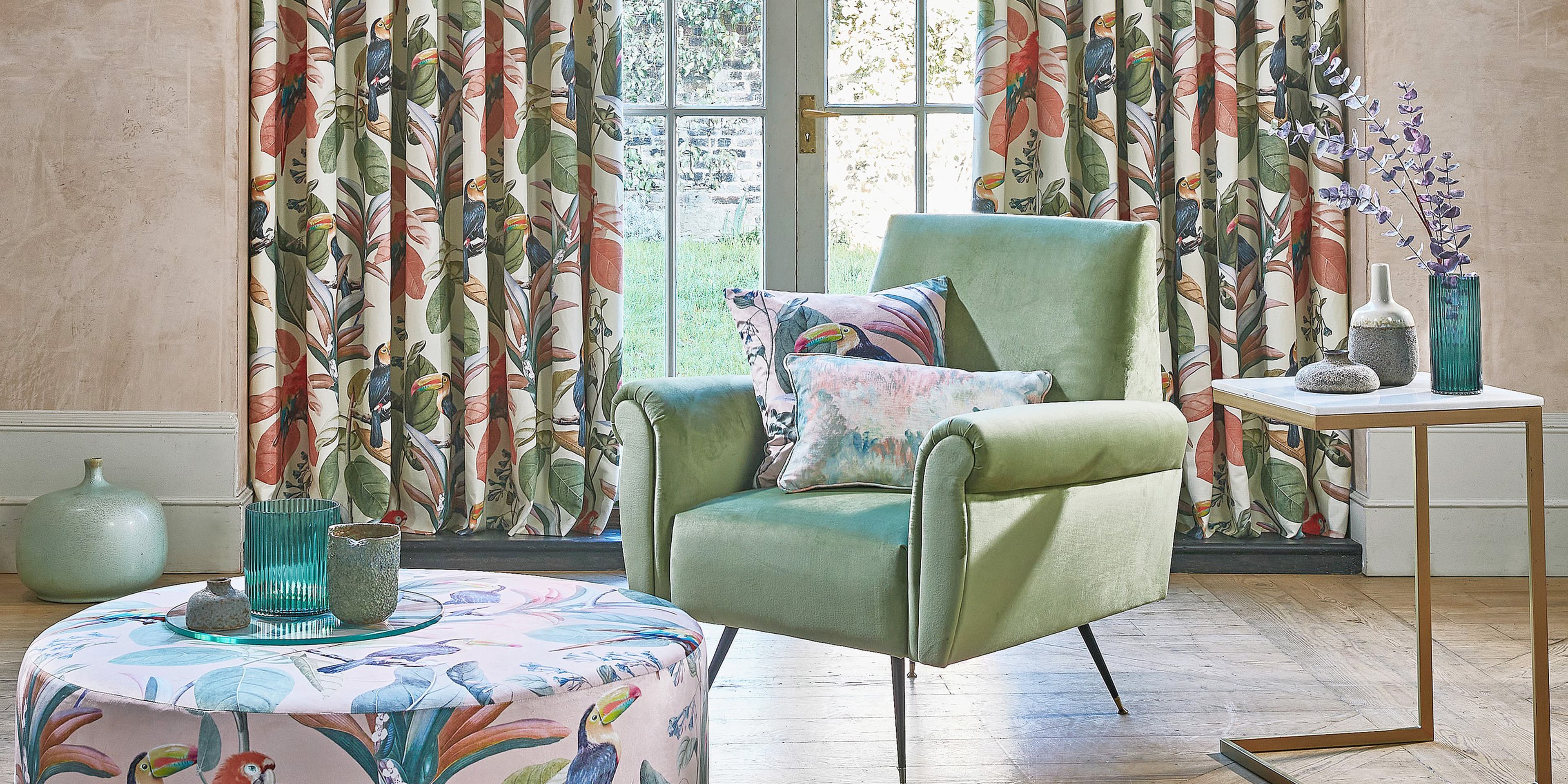
Curtains & Soft Furnishings
Luxuriously lined and hand-finished, made-to-measure curtains for every style of home.
choosing made-to-measure curtains
Made-to-measure curtains are cut and sewn to your track or pole and your chosen drop, so they hang to the sill or the floor exactly as they should. They're still the best way to add warmth, soften a room and cope with a big window or a bay. Our curtains use fabrics from Prestigious Textiles and are made in house, and each pair is lined and hung on a Silent Gliss or standard track, or on a pole.
Pinch pleat or eyelet
The heading is the top of the curtain, and it sets both the look and how much fabric goes in. A pinch pleat has its folds sewn in at regular spacing, so the curtain falls in crisp, formal columns. Prestigious make double pinch pleats at roughly twice the width of the track and triple pleats at about two and a half times, which is why pinch pleats look so full. They hang on a track or on a pole with rings.
An eyelet curtain has metal rings punched through the heading and threads straight onto a pole, falling in large, soft, even waves. It is simpler and more contemporary, and it suits a plain modern room or a patio door. Eyelets only work on a pole, so if your window needs a track for a bay, a curve or a tight ceiling, a pinch pleat is the better choice.
Linings, interlining and warmth
What goes behind the face fabric matters more than most people expect. A standard lining protects the cloth from sunlight and helps it hang well. We make curtains with blackout, thermal and interlined linings. Blackout lining is for bedrooms and nurseries. Thermal lining and interlining, a thick soft layer sewn between fabric and lining, add weight, fuller folds and real insulation; Prestigious describe their hand-sewn interlining as adding heat retention and sound insulation. In an old stone cottage or a house exposed to the wind off the coast, interlined curtains drawn at dusk make a difference you can feel.
Tracks, poles and bay windows
Silent Gliss is a Swiss track maker whose tracks come as hand-drawn, corded or electric systems for walls or ceilings, and we fit all three. For a bay, the track is bent in the factory to the exact angles of your window, so the curtains run right round in one sweep instead of stopping at each corner, and Silent Gliss give a five-year warranty on their products. For a simple straight run, a standard track or a pole does the job well. At the survey we measure track and drop together, because a curtain made to the wrong heading height never hangs properly.
common questions
How much wider than the window should curtains be?
The track or pole usually runs past the window on each side so the curtains can stack back off the glass when open. The curtains are then made with extra fullness on top of that width. Pinch pleats use around two to two and a half times the track width in fabric. We work all of this out at the survey.
Should curtains touch the floor or stop at the sill?
Floor-length curtains look more generous and insulate better, and they suit living rooms and bedrooms. Sill-length is more practical above a radiator, a window seat or a deep stone sill you actually use. Where a radiator sits under the window, a Roman blind in the same fabric is often the better answer.
Can you make curtains for a bay window?
Yes. Bays are where made-to-measure really earns its keep. We fit a track bent to the shape of the bay, then make the curtains to the finished track length so they draw right round and close properly in the middle, with no gaps at the corners.
Are thermal or interlined curtains worth it?
For draughty older windows, single glazing and north-facing rooms, yes. Interlining adds a thick layer between fabric and lining that holds warmth in and dampens noise. It also makes the curtain heavier, so the track or pole has to be up to the weight, which we allow for when we specify it.