
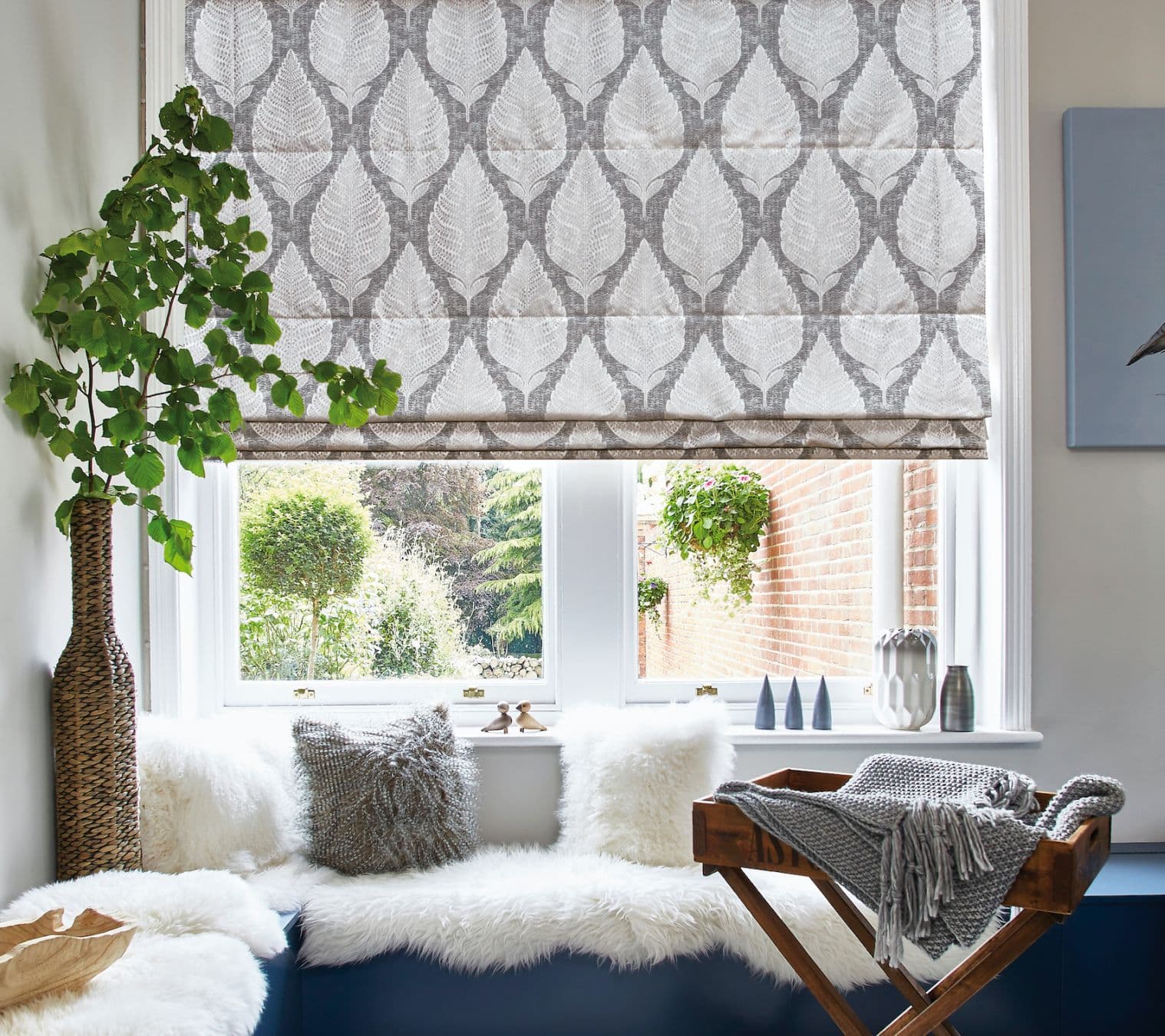
Roman Blinds
Timeless elegance with clean, structured folds — crafted to your exact measurements.
choosing a roman blind
A Roman blind is a flat panel of lined fabric that draws up into soft, even folds as you raise it. It gives you the warmth and pattern of a curtain in the space of a blind, which suits bedrooms, living rooms and windows where a curtain would foul a radiator or window seat. Our Roman blinds use fabrics from Prestigious Textiles, in cotton, linen and blended weaves, and are made in house.
How a Roman blind is made and works
Behind the face fabric sits a lining, and stitched across the back at intervals are rods that keep each fold straight. Cords run from the bottom of the blind up through rings to a headrail, and a side chain winds them onto a drum so the blind lifts from the bottom, fold stacking on fold. When it is down you see one flat, uninterrupted piece of cloth, which is why Romans show off a pattern better than almost any other blind.
That stack of folds is the trade-off. A Roman doesn't roll away into a slim tube the way a roller does, so when raised it still covers the top of the window. On a tall sash that hardly matters. On a small cottage window it can take a real bite out of your daylight, and the usual answer is to fit the blind above the recess so the folds sit on the wall.
Linings and how dark a room will get
The lining decides how the blind behaves as much as the fabric does. A standard lining gives the folds body and lets a soft glow through. Blackout lining is the choice for bedrooms, though no stitched blind is completely dark: the stitching that holds the rods leaves tiny pinholes, and a little light shows at the edges. Interlining, a soft layer between face fabric and lining, adds fuller folds and some insulation on a cold window. Down here the light off the sea is strong, and a lining is what stops a south-facing window fading your fabric, which is why we always make a Roman lined.
Inside or outside the recess
Thick stone walls and deep reveals are common in older Cornish and Devon houses, and they give you a choice. Fitted inside the recess, a Roman looks built in and leaves the wall clear, but the folds sit on the glass when raised. Fitted on the wall above, it makes a small window look larger and lets in every bit of light. At the free home survey we measure for both and can show you where the stack will sit before anything is made.
common questions
Are Roman blinds suitable for a kitchen or bathroom?
Usually not the best choice. Fabric Romans absorb steam and cooking smells and cannot be wiped down, and damp can mark the lining. Above a sink or in a shower room we would normally point you towards a moisture-resistant roller or a faux wood Venetian instead, and keep the Roman for a dining end or a window away from the steam.
Roller or Roman blind, which should I choose?
A roller rolls up almost out of sight and suits practical rooms and tight spaces. A Roman is softer and warmer and shows a patterned fabric properly, but its folds take up window height when raised. For a living room or bedroom with a little wall above the window, the Roman is usually the nicer one to live with.
Are Roman blinds safe with young children?
They are chain operated, so child safety matters. All our blinds meet EN 13120 and the BBSA Make It Safe guidance, which means a breakaway or tensioning device on the chain and safety fittings on the rear cords. Even so, we always advise keeping cots, beds and furniture away from any corded window.
Can a Roman blind match my curtains or cushions?
Yes. Many of the same fabrics are used for our made-to-measure curtains, so a Roman in a bay can match curtains on a patio door in the same room. Wide windows may need the fabric joined, and a patterned cloth is matched across the join.