
Five years ago, motorised blinds were a luxury most homeowners only encountered in high-end hotels and aspirational interior design magazines. Today, they're one of the most frequently requested products in our showroom — driven partly by falling costs, partly by the explosion of smart home technology, and partly because once you've lived with motorised blinds, manually adjusting individual cords and chains feels like a step backwards.
This guide covers everything a homeowner in Cornwall or Devon needs to know about motorised blinds in 2025 — how they work, what they integrate with, how much they cost, and where they make the most sense in a home.
How Motorised Blinds Work
A motorised blind replaces the manual cord or chain mechanism with a compact tubular motor — either built into the roller tube (for roller blinds) or integrated into the head rail (for Roman, Venetian, and other types). The motor is controlled by a radio frequency signal from a remote, wall switch, smartphone app, or smart home system.
The motor has programmable limits — it knows exactly how far to extend and retract the blind, stopping precisely at the position you've set rather than relying on manual judgment. This means every operation is smooth, consistent, and silent.
Power Options — Mains, Battery, and Solar
Mains-Powered Motors
The most reliable option for permanent installations. A mains motor requires a 240V supply routed to the blind head rail — ideally during a renovation or new-build when cabling can be hidden in the wall. For existing properties, a qualified electrician can often route cables discreetly, but it's worth assessing the practicality before committing to mains operation.
Rechargeable Battery Motors
The most versatile option for retrofit. A rechargeable lithium-ion tubular motor charges via USB-C (typically every 6–18 months depending on usage) and requires no electrical work. For most homes, battery motors are now the default recommendation — the convenience of not requiring electrical installation outweighs the occasional recharge.
Solar-Powered Motors
A small solar panel — typically positioned above the window or at the top of the blind — charges the motor continuously, eliminating the need for any wired connection or manual recharging. Ideal for south-facing windows in Cornwall and Devon's reasonably sunny climate, and the obvious choice for apex or conservatory roof windows where electrical access is impractical.
Smart Home Integration — What Works With What
- Somfy TaHoma: Rogers' most commonly specified system — app control, grouping, scheduling, and compatibility with Alexa and Google Home
- Lutron Caséta and Homeworks: Premium integration, works seamlessly in high-spec properties alongside Lutron lighting
- Control4 and Savant: Professional home automation systems, requires integration by a certified AV installer
- KNX and Crestron: Commercial and high-end residential, for whole-building automation
- Alexa and Google Home: Direct voice control without an additional hub — works with Somfy TaHoma
- Apple HomeKit: Compatible via bridge adaptors on some Somfy systems
Sun and Wind Sensors — The Smart Automation Layer
Beyond app and voice control, motorised blinds can be connected to sun sensors and wind sensors that trigger automatic operation based on environmental conditions. A sun sensor can be set to lower a south-facing blind when light intensity exceeds a threshold — protecting your furnishings and managing room temperature without any manual action. A wind sensor (more commonly used with awnings) triggers automatic retraction when wind speed exceeds a safe level.
For homeowners with large areas of south-facing glazing — common in the new-builds and architect-designed homes we see increasingly across Cornwall and Devon — sun sensor automation is one of the highest-value features we install.
Which Rooms Benefit Most from Motorisation?
- Large living room glazing: Effortless control of multiple blinds simultaneously
- Bedroom blinds: Close every blind at bedtime from the bed, without getting up
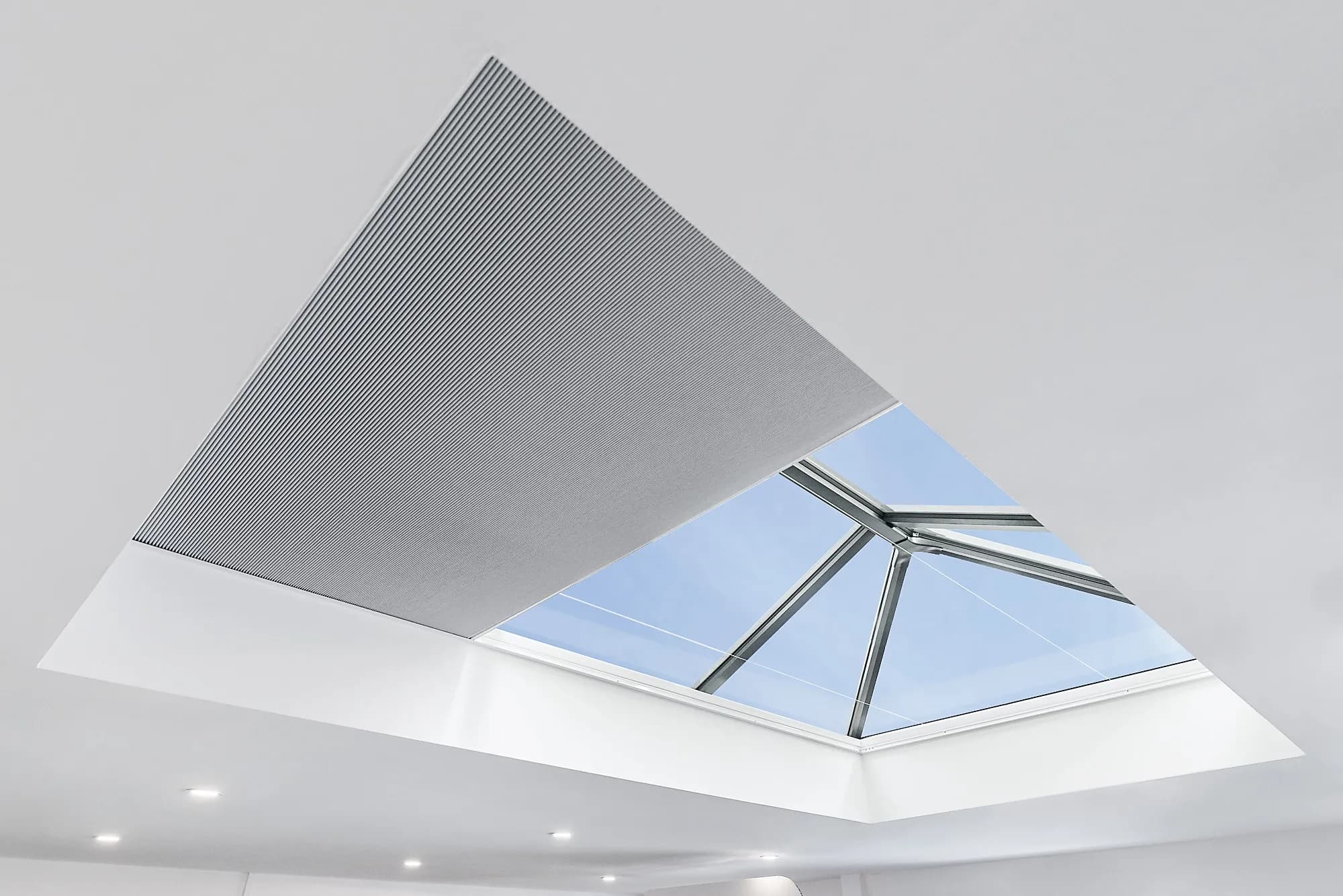
- Hard-to-reach windows: Skylights, apex windows, mezzanine glazing, and high-level windows that are impossible to reach manually
- Conservatories: Multiple blind zones controlled from a single remote or app
- Home offices: Respond quickly to changing light without interrupting work
- Properties with very young or elderly occupants: Removes the need to manipulate cords and chains
What Does Motorisation Add to the Cost?
The honest answer: less than most people expect. A battery-powered tubular motor adds approximately £80–£150 per blind to the cost of a manually operated equivalent, depending on the motor specification and the size of the blind. For a bedroom roller blind, that might mean the difference between £90 and £200. For a large living room roller blind, between £150 and £280.
When you consider that a motorised blind will outlast two or three manually operated equivalents (because the mechanism is never stressed by rough handling or cord knotting), the additional cost often represents genuine value over the life of the product.
Interested in motorised blinds for your home? Book a free survey and our specialist will demonstrate the options and advise on the best system for your property and budget.
Book Free Survey