
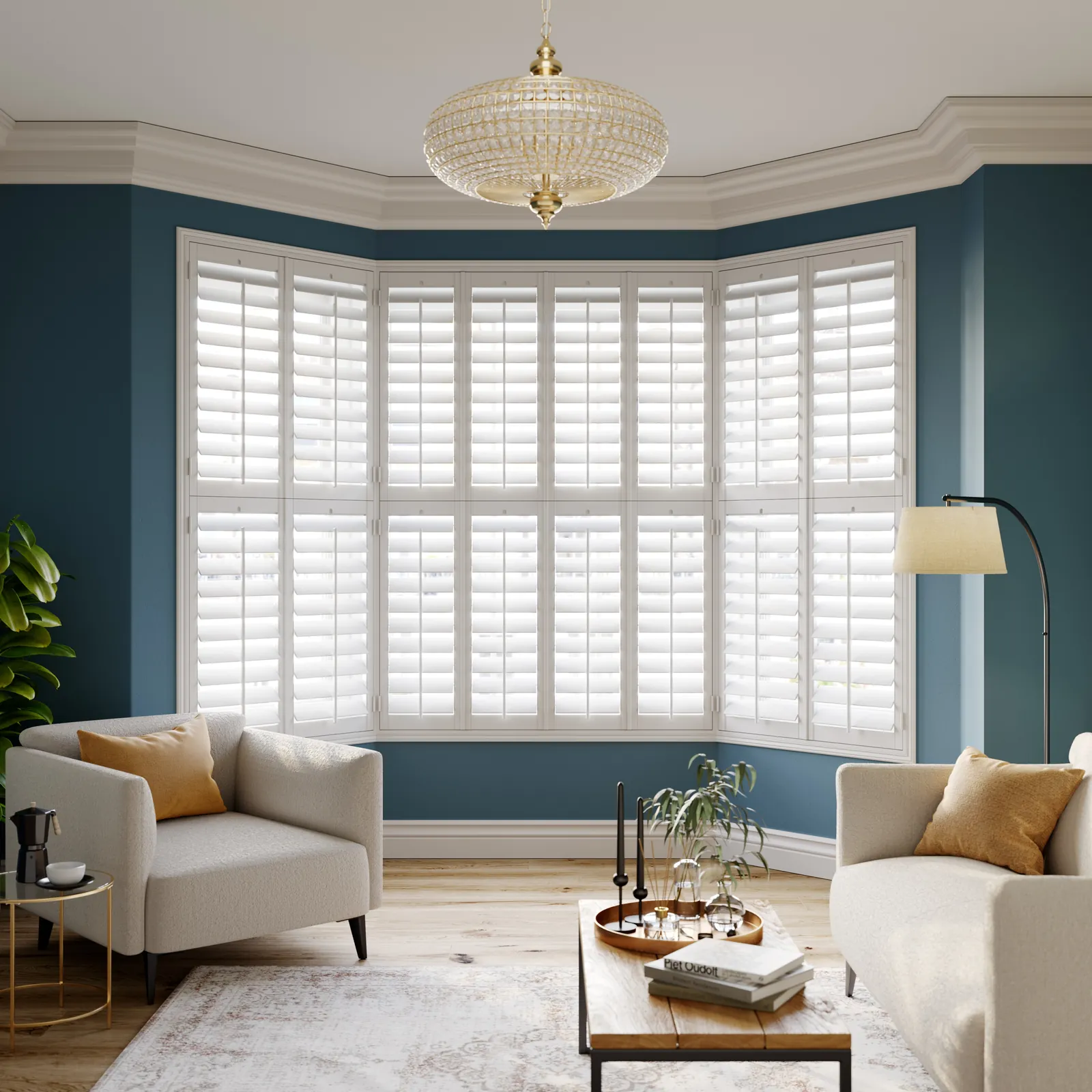
Plantation shutters are the most significant investment you can make in window coverings — typically costing three to five times the equivalent made to measure blind. Whether that investment is justified depends on your priorities, your property, and how long you're planning to stay.
We sell both shutters and blinds, and we have no financial incentive to push you toward one or the other. What we do have is 114 years of experience advising homeowners across Cornwall and Devon on which choice suits their specific situation. This comparison is as honest as we can make it.
Light Control and Privacy
On light control, shutters win. The louvre blades can be adjusted from fully open (maximum light and view) through a full range of angles to completely closed — giving you more granular control over the light entering a room than any blind type provides. You can tilt the louvres to direct light toward the ceiling for a bright, diffused effect, or angle them downward for maximum privacy while still admitting some light.
Blinds offer good light control — particularly day/night (vision) blinds and Venetian blinds — but the range of adjustment isn't as smooth or as precise as a well-made shutter. For rooms where light management is a priority (studies, media rooms, south-facing bedrooms), shutters hold a clear advantage.
Aesthetic and Interior Value
Shutters look like a permanent, designed-in feature of the room. They frame the window architecturally, add depth and interest, and have a quality that registers immediately — even when closed. For the Victorian bay windows of Plymouth's Mutley and Peverell streets, the granite-framed windows of a Cornish coastal cottage, or the tall sash windows of a Georgian terrace in Exeter, shutters are transformative.
Blinds, however good, look like blinds. That's not a criticism — a beautifully specified Roman blind in a quality fabric adds warmth, texture, and character to a room. But the two products occupy different aesthetic categories, and it's worth being clear-eyed about that when making the investment decision.
Longevity and Durability
Shutters, when properly maintained, last the lifetime of the property. We routinely see shutters that are thirty or forty years old still functioning perfectly. There are no fabrics to fade, no cords or chains to break, no mechanisms to fail. The louvre adjustment rod is the only component under regular mechanical stress, and it's easily replaced.
Good quality made to measure blinds last ten to fifteen years with normal use. Budget blinds last three to five. Over the lifetime of a property, the relative cost of shutters versus replaced blinds narrows considerably — and on a long enough time horizon, shutters can represent genuinely better value.
Property Value
Shutters are one of a small number of interior features that estate agents consistently cite as positively affecting property value and saleability. In the estate agent vernacular: they 'add kerb appeal', they 'make a room feel finished', and they 'photograph beautifully'. In practical terms, a surveyor is likely to treat shutters as a fixture and fitting that adds to the property's desirability rather than a decorative item that can be taken when you leave.
Blinds, however lovely, don't carry the same weight. They're expected — part of the baseline that buyers assume a property will have — rather than a feature that enhances perceived value.
When Blinds Are the Better Choice
- When your budget doesn't stretch to shutters — a beautiful Roman blind is infinitely better than no window covering
- When you want colour and pattern — shutters are typically white or neutral; blinds offer endless fabric choice
- Conservatories and non-standard windows — where shutters can't be fitted
- Rented properties — shutters are a significant investment in someone else's asset
- When you're unsure about staying — blinds are easier to take with you or replace
Our Honest Recommendation
If you own your home, plan to stay for more than five years, and are willing to invest properly in the windows of your main living rooms and bedrooms — shutters are worth it. If any of those conditions doesn't apply, invest in the best quality made to measure blinds you can afford. The difference between a premium made to measure blind and a budget one is far more significant than the difference between a made to measure blind and a shutter.
Not sure which is right for your home? Book a free survey and our specialist will bring shutter and blind samples, advise honestly, and let you make the decision without pressure.
Book Free Survey